2024 National Children’s Month Celebration: "Break the Prevalence, End the Violence: Protecting Children, Creating a Safe Philippines"
2024 National Children’s Month Celebration: "Break the Prevalence, End the Violence: Protecting Children, Creating a Safe Philippines"
The observance of National Children’s Month in the Philippines is a crucial annual event, allowing us to pause and reflect on the state of child protection across the country. This year's theme, *“Break the Prevalence, End the Violence: Protecting Children, Creating a Safe Philippines,”* challenges us to confront the serious issue of child abuse in all its forms. From physical violence to emotional trauma and sexual exploitation, children in the Philippines are unfortunately still vulnerable to many threats. While there have been positive efforts to raise awareness and implement laws, much more needs to be done to ensure that children are not only shielded from physical harm but also protected in ways that support their emotional and mental health. This national observance calls upon all sectors of society, from government agencies to community organizations, to unite in the fight against violence and abuse.
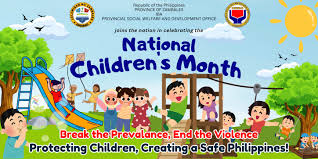
This year’s theme calls for a comprehensive, coordinated effort to prevent and end all forms of violence against
children. It reminds us that simply enacting laws and policies is not enough; these measures need to be followed by diligent enforcement. The protection of children requires the combined efforts of various sectors: government agencies, schools, communities, and families must all collaborate to provide a safe and nurturing environment for children. This theme encourages us to broaden our view of child protection, emphasizing that it’s not just about the absence of physical harm but also about fostering a safe space where children can develop emotionally, psychologically, and intellectually. It is critical to create programs that empower children and educate adults about the signs of abuse and the importance of prevention.
children. It reminds us that simply enacting laws and policies is not enough; these measures need to be followed by diligent enforcement. The protection of children requires the combined efforts of various sectors: government agencies, schools, communities, and families must all collaborate to provide a safe and nurturing environment for children. This theme encourages us to broaden our view of child protection, emphasizing that it’s not just about the absence of physical harm but also about fostering a safe space where children can develop emotionally, psychologically, and intellectually. It is critical to create programs that empower children and educate adults about the signs of abuse and the importance of prevention.

As we celebrate National Children’s Month, we are reminded that child protection is not just the responsibility of authorities but of everyone. Each of us must assess how we can contribute to ensuring the safety and well-being of children in our communities. Whether it’s through supporting existing policies, advocating for stricter enforcement, or simply being more vigilant and proactive in our own homes, every effort counts. This month serves as a call to action for individuals and communities to reaffirm their commitment to creating a safer, more protective environment for children—a place where they can thrive without fear of violence. With stronger partnerships and unwavering dedication, we can forge a future where every child is protected, valued, and free to grow in a nurturing, secure environment.
References:
UNICEF
Comments
Post a Comment